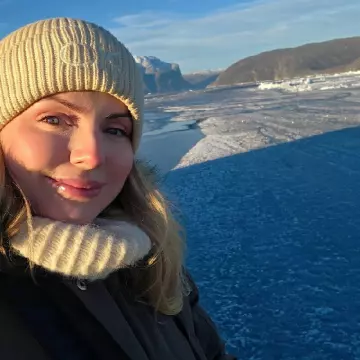
Meet the Woman Who Swims in the Arctic Year-Round:
"Painful, But Manageable"
Siv Gyda Aanes (40) believes there are several health benefits to swimming outdoors year-round.Linn Ophaug
Ice bathing is trending along the Norwegian coast. In Bodø, Siv Gyda Aanes (40) uses the cold winter sea as a way to recharge - both physically and mentally.
The wind is icy against clothes and cheeks as it ripples through the streets in the center of Bodø. In the port of Bodø, waves hit the dock and the thermometer shows -1 ℃, but the wind from the North makes it feel significantly colder.
Most of the people who have made their way outside on this Wednesday morning have put on many warm layers. Their scarves cover half of their faces, and their shoulders are hunched up to their ears.
Within the locker room at Pust Sauna, Siv Gyda is going in the opposite direction. She is not getting dressed; she is getting undressed.
Pust Sauna in the port of Bodø.Linn Ophaug
"A unique calm"
"I'm not very fond of swimming without using the sauna first," says Siv Gyda before she disappears into the steaming room.
The wind is howling outside the walls and the contrast to the icy sea waiting outside could hardly be greater.
In February, the temperature in the sea in Bodø averages around four degrees. Soon, the thoroughly warmed body will face the winter air and ocean, at just a few degrees above freezing.
For many, winter swimming is about adrenaline and pushing limits. For Siv Gyda, it is about something more.
"It provides a unique calm and energy, almost like an on and off switch. Perhaps even more so in the winter than the summer."
Siv Gyda opens the door to the cold and jumps into the bitter sea.
Siv Gyda takes the plunge and jumps into the sea.Linn Ophaug
Siv Gyda takes the plunge and jumps into the sea.Linn Ophaug
Siv Gyda takes the plunge and jumps into the sea.Linn Ophaug
Siv Gyda takes the plunge and jumps into the sea.Linn Ophaug
Siv Gyda takes the plunge and jumps into the sea.Linn Ophaug
Siv Gyda takes the plunge and jumps into the sea.Linn Ophaug
Siv Gyda takes the plunge and jumps into the sea.Linn Ophaug
Siv Gyda takes the plunge and jumps into the sea.Linn Ophaug
Siv Gyda takes the plunge and jumps into the sea.Linn Ophaug
Stress response and cold shock
Ice bathing has become significantly more popular in recent years, and floating saunas can be found all along the coast. At the same time, interest from research communities has grown. However, the knowledge base is still limited.
"The problem is that we often have small sample groups. There are not many test subjects in this type of study," says Associate Professor at Nord University, Dagmar Dahl.
She is an avid ice swimmer herself and has conducted a lot of research on how ice bathing affects the body.
"There is an immediate stress response and a cold shock. The heart starts beating faster, and your breathing and adrenaline increase."
"At the same time, having your face in the water can trigger the so-called diving reflecx, which works in the complete opposite way."
"The cold shock says 'beat faster, breathe faster.' The diving reflex says 'beat slower, breathe slower.' These signals can, at worst, confuse the heart."
For healthy individuals, this usually goes well, but for people with underlying heart problems, the combination can be risky.
Dagmar Dahl has a lot of experience with ice swimming.Linn Ophaug
Several health benefits
Over time, repeated cold exposure can help regulate blood pressure and strengthen the cardiovascular system. Several people also report better mood and reduced stress, explains Dahl.
"When you consciously slow your breathing in the cold, you stimulate the parasympathetic nervous system. You teach your body to counteract stress. It's almost like doping, there is a rush of endorphines."
According to the researcher, the motivation is about more than measurable health benefits.
"The mental aspect is important, the nature experience, the intensity, and the sense of accomplishment."
But the cold must be taken seriously. Hypothermia can occur if you stay in the water too long, and the euphoria afterward can make you underestimate the risk.
The recommendation is therefore to gradually warm up again, get into dry clothes quickly, and preferably drink something warm.
Hot and cold
For Siv Gyda, traditional saunas in water parks have never been tempting. But when the first floating sauna in Bodø opened in 2021, she gave it a shot.
It was the start of year-round bathing.
"You get that contrast between the icy sea and the warmth inside. That makes all the difference."
The contrast is the whole point. It's the interplay between the extremes that makes her come back.
Now, she tries to take a bath at least once a month, and the encounter with the water is just as intense every time.
"When you get into the water, it's all about breath control. The cold shock, the pain, all the sensory input hits you at once."
It's about getting in touch with your breathing and taking control of your body.
Siv Gyda Aanes
"Painful"
She doesn't hide the fact that it's painful for those who have never tried it.
"It is painful, but it's manageable. And when you're really warm from the sauna, it's actually very nice to cool down," she says with a smile.
Afterwards, she notices the difference.
"It helps with stress and racing thoughts. You get a completely different connection with yourself. It's one of the few things that truly gives a restart."
Ice bathing has also become something she shares with others. When she turned 40, she chose to celebrate oceanside. She rented the sauna and invited guests to the sensory experience.
"Many were skeptical, but they thought it was great afterwards."
She describes it as a different way to gather.
"You're a bit undressed and warm, and then you do something challenging together," she explains.
Siv Gyda comes up from the water with a big smile.Linn Ophaug