politics
Arctic Guardian 2025: Multilateral Exercise on Maritime Emergency Response off Northern Norway
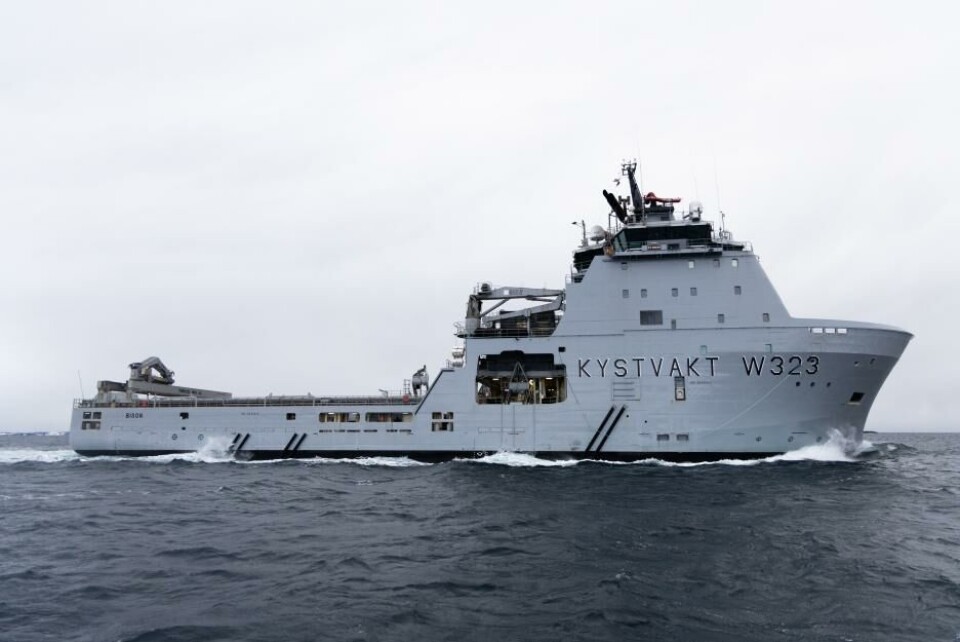
The exercise, which gathers coast guard resources from the seven Western Arctic states, is underway. "In a changing Arctic, it is crucial that we train together, build trust, and understand each other's capabilities," says the Commander of Norway's Coast Guard.


Published
Modified
Les original versjon på norsk.
The Arctic Guardian exercise takes place from April 8th to 9th off the coast of Troms county, Northern Norway.
It is led by Norway as chair of the Arctic Coast Guard Forum (ACGF), an operationally-driven organization, and includes resources from all the other western Arctic countries – Canada, Denmark, Finland, Sweden, Iceland and the USA.

"The central exercise scenario involves a cruise ship and an oil tanker collision. Thus, the exercise consists of a major operation to save lives and concurrently fight oil pollution," says the Spokesperson of the Norwegian Navy, Commander Kjartan Sildnes, to High North News.
The coordination of international efforts in the event of critical incidents in Arctic waters is becoming increasingly relevant, he points out.
"The Arctic region is inherently difficult to operate in, both regarding climate and geography. This type of joint exercise is also extra important in light of climate change and increased maritime activity in Arctic areas – combined with low availability of resources for search and rescue and environmental preparedness."
Arctic Guardian 2025 was first reported on by the Norwegian National Defense Magazine.

Shared responsibility
More concretely, coast guard vessels, oil spill response vessels, and aircraft – as well as other relevant agencies – are now in action to strengthen Arctic maritime emergency response.
The central institutions on the Norwegian side are the Coast Guard, the Coastal Administration, and the Joint Rescue Coordination Centre of Northern Norway.
“In a changing Arctic, it is crucial that we train together, build trust and understand each other’s capabilities. Arctic Guardian 2025 demonstrates professionalism, preparedness and shared responsibility for safety and the environment in the High North,” says the Commander of the Norwegian Coast Guard, Commodore Oyvind Dunsaed.
He leads the cooperation in the Arctic Coast Guard Forum during the Norwegian chairship.
Revitalized after various 'waves'
Arctic Guardian is initially an annual exercise
It was last held in 2021 by the Arctic Coast Guard Forum and the Arctic Council's Emergency Prevention, Preparedness and Response Working Group (EPPR), with Iceland as the host nation and all other Arctic countries as participants.

This edition was designed to improve cooperation between the ACGF and the AC based on two binding agreements entered into by all the eight Arctic states within the framework of the council: on maritime search and rescue (2011) and oil spill preparedness and response (2013), respectively.
"In later years, the exercise series has been impacted by both the COVID pandemic and the security policy situation," informs Sildnes.
The 2021 exercise was meant to take place physically but had to be converted to a virtual version due to infection control.
In February 2022, Russia launched the full-scale invasion of Ukraine – and the cooperation with the Russian side in the ACGF was put on hold. This also had consequences for the meeting and exercise activities.
The forum's Western participants did not meet until April 2024 in Trondheim, Central Norway, where they conducted a tabletop exercise.
"The connection with Russia within the forum is still on hold, and there has been no contact with the Russian side regarding Arctic Guardian 2025," says Sildnes.
At the same time, he can confirm that the Norwegian-Russian practical cooperation on search and rescue and oil spill response in the Barents Sea is still functioning at an operative level within bilateral agreements.
Facing new political waves
After Donald Trump's re-entry to the White House, US participation in Arctic cooperative activities such as the Arctic Guardian is not a given.
Trump's stated plans to annex Canada and Greenland, which is part of the Kingdom of Denmark, also put significant pressure on Western Arctic relations.
The waves in the wake of the Trump administration are considerable. Still, they have not impacted the Arctic coast guard cooperation so far, according to Sildnes.
However, the US Coast Guard ship USCGC Calhoun is not participating in Arctic Guardian 2025 as originally planned and announced.

“The reason is operational priorities on the American side. The US Coast Guard emphasizes that this does not affect their long-term commitment to the Arctic and that they remain committed to cooperation in the Arctic Coast Guard Forum. We still have Americans on the staff for the exercise," Sildnes informs.
Confirmed participating units in the exercise are the Norwegian Coast Guard vessels NoCGV Hopen, Bison and Farm, the Danish frigate HDMS Thetis (which solves coast guard tasks), the Icelandic Coast Guard vessel ICGV Thor, and oil spill resources (including in the form of vessels) from Canada, Finland, and Sweden.
"All see the value of cooperation"
"The Norwegian Coast Guard's experience is that cooperation across the Western countries in the Arctic Coast Guard Forum is still as it has been: both close and good. The current overarching security policy landscape has not impacted the forum internally in any way in our experience," says Sildnes and continues:
"I believe that all the participating Arctic nations see the value of cooperation on search and rescue, oil spill response, and managing various maritime scenarios. Everyone considers it very important to help each other in the North in the event of serious maritime incidents."
Side scenario: Nuclear incident
Arctic Guardian also includes a more theoretical exercise on maritime nuclear preparedness, according to Sildnes.

"This will be a table-top exercise on the management of an incident where radioactive materials are suspected to be involved and where one considers how this could affect search and rescue and environmental preparedness operations. The objective is to test procedures, interaction, and notifications – not the physical handling of such material," he elaborates.
Practicing the management of nuclear accidents at sea is not least relevant in light of regular calls by US, British, and French reactor-powered vessels to Norway, especially in the North.
The visits mainly occur in open waters, but they are also conducted at special reception ports: Port of Grøtsund outside Tromsø and Haakonsvern Naval Base outside Bergen.
On average, eight nuclear submarines (mostly American) visit the Port of Grøtsund annually, according to the Norwegian Home Guard. In total, Norway receives 30-40 calls from reactor-powered vessels per year, according to the Norwegian Radiation and Nuclear Safety Authority.
Also read


-

Is the Arctic Prepared for a Large-Scale Cruise Ship Incident?
-

Arctic Military Leaders Met Near the Norway-Russia Border: Discussed Hybrid Threats
-

Joint Viking 2025: 10,000 Soldiers From 9 Nations Exercise Defending Northern Norway
-

U.S. Coast Guard Starts Construction of First New Heavy Icebreaker in 50 Years


