business
Cod Conference 2026
“Definitely See a Future for Myself in Fisheries”

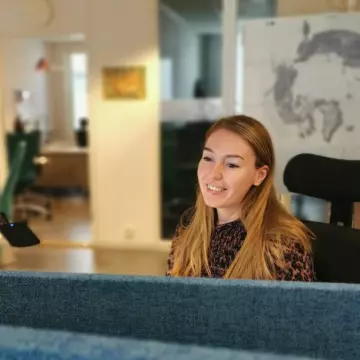
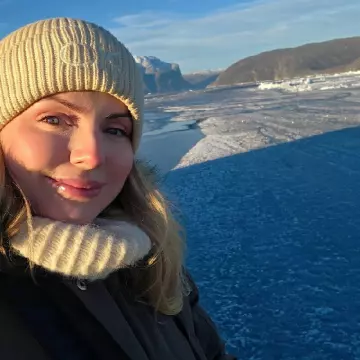
Myre, Northern Norway (High North News): Trygve Angell (19) works as a fisherman on board the trawler 'Sørkapp'. Despite lower quotas for several fish species, he is among the many young people entering the fishing profession.
Published
Modified
"I absolutely envision a future within the fisheries sector," said the young voice from the north, Trygve Angell (19), to a packed hall at the Skrei Conference in Myre, Vesterålen, Northern Norway.
Angell is an apprentice and fisherman on board 'Sørkapp,' the newest trawler of the fishing group Nergård.
From the stage, he spoke warmly about future opportunities in the industry, despite several years of quota reductions for a number of species, including the important cod in the Barents Sea, which is at its lowest since 1991.
A source of food and work

The annual Skrei Conference takes place in Myre, Vesterålen, and this year, the theme of trust serves as a common thread throughout the conference. Among other things, it highlights young people's trust in investing in cod and Northern Norway. It's about belief in the future and the importance of recruitment to the industry.
"No matter what happens in the world, there will be a need for food. One of the largest sources of food is the sea and the species that live there. The good thing about fish and other species is that they are renewable. If you have good management of the species, so that you don't overfish them, you will have an eternal source of both food and work," Angell points out, and adds:
"These are some of the aspects I find interesting about both the industry and the opportunities for jobs and careers."
"In 2024, the seafood industry exported for NOK 175 billion. That says a bit about how important the industry is for the coast and for Norway," he notes.

A varied everyday life
High North News meets the young fisherman at the conference. He talks about everyday life on board the 'Sørkapp', where Angell is involved in most of what happens, from inside the factory to out on deck.
"We produce, gut, clean, and freeze the fish. Out on deck, we bring in the trawl. Different things can happen, and that's what I like about the work. Every day is varied," he says.
For Angell, getting quickly into the job market was an important reason to start as a fisherman. At the same time, he is clear that the large industry is attractive due to the many opportunities it offers.
"I thought this was a good path to take and that it was wise to start as a fisherman. That's where it all starts. If I decide to pursue further education, I have laid the foundation," he continues.
How do you think other young people view the fishing profession?
"I think most find it exciting, a slightly different everyday life. For many, that's probably what attracts them. Maybe they're a bit tired of school too, and want to get to work."
I'm glad to see that so many want to enter the fishing profession.
Great opportunities
"Today's fishing industry is high-tech in many areas. It ranges from ship design, construction of equipment, machinists, electricians, automation and welders. And of course, fishermen, mates, skippers and cooks," Angell elaborated during his presentation at the conference.
"And you can't forget the shipping company on land. They manage finance, administration, sales, IT, and personnel. In other words, there are a number of future opportunities within a range of different fields. I have chosen a trade certificate as a fisherman. In addition, I got a coastal skipper's certificate, and I see a future at sea - whether it will be as a fisherman, or if I continue school to become a coxswain or skipper."
He is also clear that the experience is useful in many other industries as well, such as in fish reception, fishing industry and aquaculture, and on the "land side" in a shipping company.

Decline in quotas
Angell also addresses the decline in fishing quotas over recent years. However, he highlights how the industry can compensate for the reduction in years with lower quotas.
"Lower quotas mean there is less fish in the sea, so that is not good. At the same time, prices also fluctuate in cycles with the quotas," he says and adds:
"When quotas decrease, prices tend to go up, as they have in recent years. In that sense, one manages to compensate for this. It contributes to a certain stability and solidity in the industry."
"For someone who has just entered the industry, it is reassuring. It's something you think about," the young fisherman emphasises.
He is also clear about the potential in the industry, which can be found in the better utilisation of by-products.
"We have become much better at taking care of and getting more out of by-products. One tries to increase the value creation of the resources we have, and it contributes to increased operational basis and solidity."

Youth find their way into the industry
The Norwegian Minister of Fisheries and Ocean Policy, Marianne Sivertsen Næss (Labor), was also present in Myre at the Skrei Conference. She confirmed to HNN that there is an increase in young people in the fishing profession.
"It is pleasing to see that so many want to enter the fishing profession, despite us facing perhaps the toughest time since the 90s in terms of quotas and stocks."
"It shows that young people see it as a fantastic profession to enter. I have occasionally been worried that the coastal culture and identity associated with the fisheries could be lost. But this clearly shows that we have not."
She emphasises the importance of measures, including the youth fishing scheme and the recruitment scheme, which are meant to help ensure that young people find their way into the fishing sector.
"This, along with several other factors, means that the numbers are increasing overall," she concludes.


