politics
Russia Opens Massive Arctic Vostok Oil Project Despite Sustained Western Sanctions

Russia has begun exporting oil from Vostok Oil, its largest new oil development in decades, despite years of Western sanctions aimed at slowing the project. The launch marks a major expansion of Russia’s Arctic energy infrastructure and could transform the Northern Sea Route into a significantly larger oil-export corridor, with volumes ultimately reaching 100 million tonnes annually.

Published
Modified
Russia has begun loading crude from its massive Vostok Oil development in the Arctic, bringing into operation a project that Western sanctions were explicitly intended to delay or halt and that Moscow now expects to become one of the world’s largest sources of new oil production.
President Vladimir Putin on September 6 formally launched the project by ordering the first crude cargo loaded onto the ice-class tanker Valentin Pikul at the new Bukhta Sever terminal on the Taimyr Peninsula. The approximately 120,000-deadweight-tonne Aframax Akademik Gubkin was waiting offshore to take a second cargo.
Both tankers were built at Russia’s Zvezda shipyard.
The launch is particularly significant because Vostok Oil has been a target of Western sanctions. In January 2025, the U.S. government sanctioned the project’s operator and described Vostok Oil as a major Russian development from which Moscow hoped to export more than 2 million barrels of oil per day.
Washington said the measures were intended to “slow down or halt” construction and limit the project’s ability to market and export crude. Ten additional companies involved in pipeline construction were also targeted.
A new oil and gas province – one of truly global significance
Yet Rosneft has now brought the first phase online, roughly five years after construction began.
Putin called the opening an important step toward creating “a new oil and gas province – one of truly global significance,” while Rosneft CEO Igor Sechin described the event as the “birthday of the new Russian oil province.” Putin later called Vostok Oil the country’s largest oil and gas project.
Will grow Arctic shipping
The scale of the development is difficult to overstate. With investment now reaching about 4 trillion rubles ($45 billion), Vostok Oil combines existing fields in the Vankor group with major new deposits in the Payakha and other clusters across northern Krasnoyarsk Territory.
Rosneft puts the resource base at about 7 billion tonnes of high-quality oil. Earlier estimates placed the resource base above 6 billion tonnes, with potential liquid-hydrocarbon production of more than 100 million tonnes annually.
Rosneft expects the project to ship 30 million tonnes of oil annually by the second half of 2027 and as much as 50 million tonnes by 2030. Longer term, production and exports could rise to 100 million tonnes per year, depending on market demand and economic conditions.

That would make Vostok Oil one of the largest new sources of cargo for the Northern Sea Route. Though it remains uncertain the company will have the ice-capable shipping capacity to achieve those figures.
Major development
The infrastructure built to make those volumes possible is itself a major Arctic industrial undertaking. The 790-kilometer Vankor-Payakha-Bukhta Sever pipeline now links the producing areas with the Arctic coast. The system has a design capacity of 100 million tonnes per year, with 414 kilometers constructed as a double-line system.
One of its most technically challenging sections is a roughly 6-kilometer pipeline crossing beneath the Yenisei River constructed at a depth of around 50 meters. Rosneft previously described the crossing as 5.8 kilometers long, using 820-mm-diameter pipes weighing about 16 tonnes each.
At the coast, Bukhta Sever has been transformed from a remote Arctic site into an industrial export terminal. The port currently has an oil-loading berth, two cargo berths and a berth for the port’s own fleet, alongside 14 storage tanks holding 30,000 tonnes each. Full development calls for 102 tanks.
A new industrial city
The terminal has also required extensive protection from Arctic ice. More than 2,000 pile structures, each 2.5 meters in diameter and extending as much as 100 meters into the ground, were installed for a protective dam designed to keep heavy ice ridges away from the port.
The construction of an industrial city in the Arctic
The berth has 18 meters of water depth, enough to accommodate tankers of approximately 120,000 deadweight tonnes.
The project has effectively required the construction of an industrial city in the Arctic.
Rosneft says more than 50,000 people and 16,280 pieces of equipment are currently deployed at Vostok Oil facilities. Fifteen field camps are planned, while power infrastructure is being built around 15 local energy districts, 16 power plants and 9,000 kilometers of transmission lines, with generation capacity ultimately reaching 3.5 GW.
A new airport with a 3,500-meter runway is also being constructed. An 850-kilometer fiber-optic connection from Krasnoyarsk is being laid to support communications across the project area.
Satellite images reveal the scale of the construction.
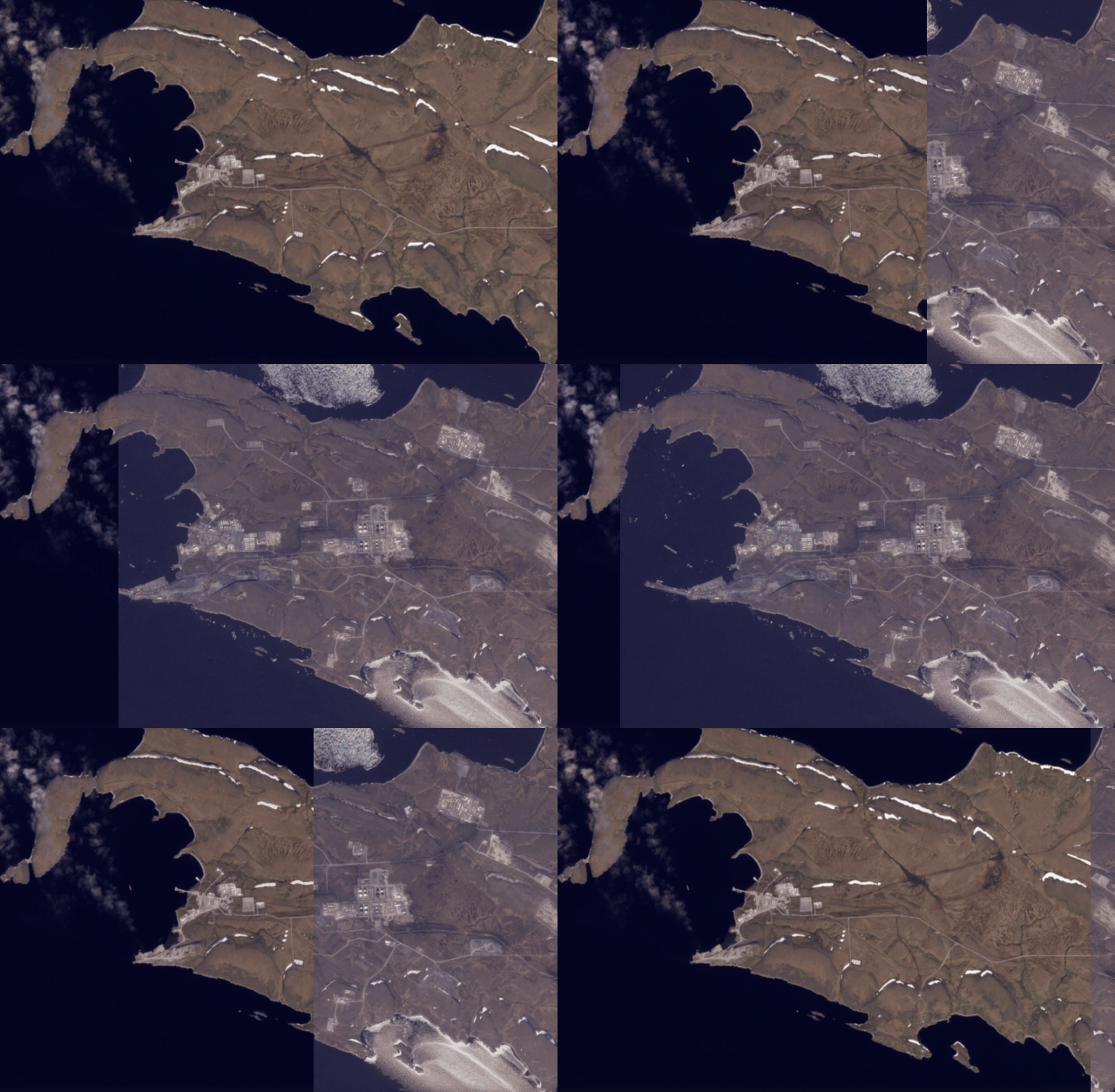
The construction itself has already created a substantial Arctic shipping market. More than 2 million tonnes of construction materials were delivered to Sever Bay during the 2023 and 2024 navigation seasons, with ocean-going vessels and river barges completing more than 700 supply voyages in 2024 alone.
Without Western partners
Vostok Oil was originally conceived as a project in which international companies would play a substantial role. Rosneft sold a 10% stake to Swiss commodities trader Trafigura for about 7 billion euros in 2020, followed by a 5% stake to a consortium of Vitol and Mercantile & Maritime in 2021.
Both positions were subsequently sold after Russia’s invasion of Ukraine, with Trafigura exiting in July 2022 and the Vitol-led consortium divesting later that year.
Rosneft had also been courting other major international energy companies.
At the launch ceremony, Sechin used the occasion to address several of them directly, naming former BP CEO Bob Dudley, former ExxonMobil CEO Rex Tillerson, former Exxon executive Neil Duffin, current ExxonMobil CEO Darren Woods and Exxon senior vice president Neil Chapman.

Sechin said they were among the global industry leaders with whom Rosneft had discussed the prospects of Vostok Oil.
The project therefore represents not simply the opening of another Russian oil field, but a demonstration of Moscow’s ability to continue developing major Arctic energy infrastructure after the collapse of the Western investment and technology relationships that were originally expected to support it.
Massive increase in cargo
It also represents a major bet on the future of Arctic shipping.
At 100 million tonnes a year, Vostok Oil would require a fleet of dozens of large tankers operating through Arctic waters. Rosneft has previously planned a dedicated fleet of high-ice-class vessels for the project, while Russia has struggled to expand its supply of such ships under sanctions.
Valentin Pikul, an approximately 69,000-dwt Arc6 tanker, is among the first products of that effort; Akademik Gubkin is one of the larger Aframax vessels intended for the system.
It remains to be seen if or to what degree Moscow will expand the use of conventional, non-ice class tankers along the route. The first such vessels transited the Arctic in recent years raising concerns among environmental advocats.
The resulting oil flows could substantially alter the geography of Arctic shipping. Russia transported about 13 million tonnes of crude through the Arctic in 2025.
The European market remains off limits due to sanctions.
Even the 30-million-tonne Vostok Oil target would therefore represent several times the existing annual Arctic crude trade, while 100 million tonnes would fundamentally change the scale of oil movements through the Northern Sea Route. Again, the timelines to achieve those volumes remain uncertain due to tanker availability.
Most of that crude is expected to move toward Asian and Asia-Pacific markets, although Russian officials have also spoken of western destinations, but the European market remains off limits due to sanctions.
The development of Vostok Oil is also relevant for US and Alaskan policymakers. As the volumes increase, substantially more Russian crude will have to pass through the Bering Strait and Alaskan waters on voyages from the Arctic toward the Pacific.


