business
The crisis in the contracting industry in the North:
"Smaller Construction Companies Are on the Verge of Disappearing”

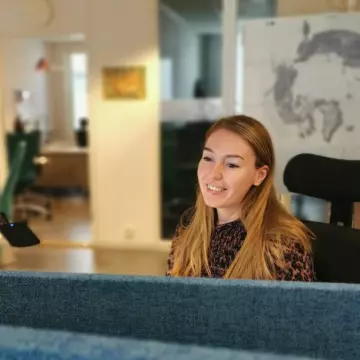
Fauske, Northern Norway (High North News): General Manager Karianne Laksosnes of the North Norwegian contracting company Infra Anlegg warns of a crisis in the construction industry. "Many are struggling", says Laksosnes who is concerned for total preparedness in the districts, and particularly in the North.

Published
Modified
"The civil engineering industry has been under significant pressure for a long time. Contractors are known for their ability to reorganize operations and turn on a dime, but we have been challenged for a very long time now."
The statement is made by General Manager Karianne Laksosnes of Infra Anlegg to High North News. We met her at the contractor's headquarters in Fauske, Northern Norway.
Laksosnes expresses great concern for the many small and medium-sized businesses in the districts, which are currently under pressure from several directions.
High fuel prices and numerous public requirements are just a few of the factors that have been added to the industry's problems, as fewer and fewer tenders are being put out.
The overall pressure is mounting on many enterprises in the rural districts of Northern Norway.

Fewer and fewer projects
"For our company, the situation is ok and the finances are good, but I am speaking for many others who are struggling. They have used up their reserves and options, and hardly any new projects and jobs can be found."
Laksosnes says this applies to all the northern counties. There is near-complete silence.
"Rising prices, rising interest rates, and high levels of debt in many municipalities are causing public developers to postpone costly tenders. There are hardly any new jobs coming from municipalities in either water, sewage or roads.
"Usually, the larger players are also good at bringing in subcontractors on bigger projects. There used to be plenty of work filtering down to subcontractors in the districts on several of the large road projects in Nordland, such as the E6 through Sørfold or Hålogalandsvegen. This is hardly the case anymore, as the major players also have less work and are obligated to their own employees."

Many factors of uncertainty
Laksosnes refers to several factors that create uncertainty and contribute to a challenging overall situation for many companies.
And there haven't exactly been fewer of them following the war in Iran and the closure of the Strait of Hormuz.
High fuel prices are very clearly felt in a machinery fleet where many machines consume 40-50 liters per hour. In addition, higher oil and gas prices have also increased the prices of pipe materials, the lines that are put in the ground.
"This is another blow to the contractors," she points out.

More requirements
"In addition, the authorities constantly issue new requirements and guidelines," Laksosnes continues.
Among other things, she highlights that stricter rules are being planned for zero-emission construction machinery on building sites, such as electric excavators or wheel loaders.
From 2025, for example, Oslo became one of the world's first cities to require zero-emission machinery on municipal construction sites.
Yet another pressure our industry is being subjected to.
"Many public-sector developers now require either electric machinery or newer diesel-based machinery in their projects. It is less of a problem to ask for diesel machines with the correct engine system than to replace all the old diesel machines with battery-powered machines. These are both more expensive, and you often need more of them to maintain continuous operation."
In April, the Knowledge Bank Northern Norway published a report on the Northern Norwegian business community prospects for 2026. In line with Laksosnes’ concerns, the construction and civil engineering industry expects interest rates in particular, as well as public requirements and regulations, to have the greatest impact on developments ahead, closely followed by municipal finances.
Tax on preparedness
Furthermore, Laksosnes is critical of the fact that wealth tax is calculated on the materials companies set aside for emergency preparedness.
For contractors, emergency preparedness materials can mean storing large quantities of diesel in tanks or keeping machines and other equipment on standby. But that comes at a cost.
"We are in the year of total preparedness and the government has asked contractors to improve their preparedness. In addition to expensive fuel, we must pay wealth tax on whatever we may set aside for preparedness," explains Laksosnes.
She rounds off with one of the latest issues, which she believes is putting pressure on small and medium-sized businesses, namely the proposal to advance sick pay in cases of long-term sickness absence, instead of having the Norwegian Labour and Welfare Administration pay directly.
"This is yet another pressure our industry is being subjected to, as if it were not enough already. The construction industry has been known for taking on people who, for example, have gaps in their CVs. It is sad if new requirements lead to us being unable to do this to the same extent because of the increased risk for the industry."

Fears more will give up
Laksosnes says the prolonged crisis means many small and medium-sized businesses are on the verge of disappearing.
Although this does not apply to Infra Anlegg, she knows of several companies in Nordland, Troms, and Finnmark that are now closing down or significantly reducing their operations.
It is the overall pressure that is causing these companies to consider shutting down to avoid bankruptcy. Some quite simply find no joy in carrying on, she says.
"And taking the step of closing down is quite drastic. It is not something you do lightly. Many keep trying for so long that they go bankrupt. Even if you are self-employed, we care about the employees and about the local community. We are quick to step in and take on odd jobs for the municipality, and we are also happy to sponsor local associations such as football and handball teams," explains Laksosnes.
An important part
"These companies operating out in the rural districts are also considered part of Norway's total preparedness. They are, in fact, a major part of preparedness, which is now under pressure if more and more of them disappear. I am worried about society as a whole, but perhaps especially here in the North, where we face different security challenges."
"If you look at Finnmark, places are far apart, and the distances are vast. If one contractor disappears there, there could be a long distance to the next one."

"Can help ease the situation"
What do you think are some of the solutions to all of this?
"In my view, the state should have earmarked funds for replacing, for example, water and sewer systems, which do not fall under the municipalities’ cost recovery, and which could have helped ease a crisis in a heavily pressured industry through new projects. That would simultaneously help municipalities," she says and continues:
"I have myself been municipal director for technical operations, had responsibility for water and sewerage, and know that the backlog is enormous. It is more or less impossible for municipalities to catch up on their own for various reasons, including that they cannot afford it or cannot impose such a burden on residents through fees."
"The same also applies to municipal and county roads. Much work could have begun if funding had been available. Now, municipalities are under great financial pressure to try to do everything they can to patch this up themselves."
More opportunities
In conclusion, Laksosnes is clear that there are major opportunities in several projects in the North.
"A double track on the Ofoten Line into Narvik is a completely obvious part of preparedness, and is a very good project that could also have been put out to tender. It could have contributed to keeping people working as the industry is in crisis."
"Many contractors specialize in railway work and could take on such jobs. That would also free up more projects for others. In that way, a job for one company also helps others in a sense," she concludes.


