politics
Long-Stalled Arctic LNG 2 Project Shows Signs of Life as Key Chinese Modules Head to Russia

The first Arctic LNG 2 modules to leave China in years are heading to Russia, signaling renewed movement around Novatek's stalled liquefied natural gas megaproject while raising new questions about whether the equipment will be used to revive Train 3, support the proposed Alaskan Polar LNG project, or simply be placed into storage.

Published
Key construction modules originally built for the third production line of Russia’s Arctic LNG 2 project are once again on the move from China to the Russian Arctic after a hiatus of nearly two years, raising fresh questions about Novatek’s plans for the unfinished production train and the future use of billions of dollars worth of stranded equipment for liquefied natural gas (LNG).
Two pipe rack modules intended for Train 3 of Arctic LNG 2 departed China aboard sanctioned heavy-lift vessels in late April and are currently en route through the Indian Ocean, according to ship tracking data and industry sources.
The shipment marks a significant development for Russia’s largest ongoing LNG project, whose construction and export ambitions have been severely disrupted by U.S. and allied sanctions targeting technology, financing, and shipping linked to the project.
The modules, designated 3-TMR-001 and 3-TMR-002, are the first known Train 3 components to leave China since construction on the production line largely stalled in 2024 following Russia’s full-scale invasion of Ukraine and the subsequent tightening of Western sanctions.

Their movement signals renewed activity surrounding Train 3 equipment, although it remains unclear whether Novatek intends to restart construction of the third production train itself or is pursuing other options for the unfinished assets.
The modules were constructed at the former Zhoushan Wison Offshore Engineering shipyard in China.
The yard was previously owned by Wison New Energies before reportedly being sold in February 2025 to Nantong Economic and Technological Development Zone Holding Group, a state-owned subsidiary of Nantong’s municipal government. The facility has since been renamed Zhoushan Tongzhou Offshore Engineering.
The sale followed sanctions imposed by the outgoing Biden administration on the yard for supplying power generation modules to Arctic LNG 2.
A renewed attempt to deliver
The modules have already undergone an extended and unusual journey.
The same two units were first loaded for shipment in May 2024 aboard the heavy-lift vessel Wei Xiao Tian Shi bound for Russia.
Avoids ice issues, even sanctions
But after a 10-month odyssey spanning thousands of nautical miles and mounting scrutiny from Western authorities, the vessel carrying the cargo reversed course near the Faroe Islands and returned to China, eventually unloading the modules at Dongzao Gang port north of Shanghai.
The cargo then remained stationary for nearly 16 months.
That changed in April when a Chinese heavy-lift barge moved the modules once again. Automatic Identification System (AIS) tracking data and satellite imagery showed the barge Si Hang Yong Xing transporting the units from Dongzao to Mao Jia port on April 18 and April 25.
Vessel-detection data from Synmax’s Theia platform were instrumental in identifying the heavy-lift barge and tracking the transfer of the modules between ports before they were loaded aboard oceangoing transport vessels.
High-resolution satellite imagery provided by DataDesk and sourced from Planet Labs further enabled visual confirmation of the modules’ transfer and loading operations at both ports.
Mao Jia port was also used during a September 2024 loading operation involving modules destined for Train 2 of Arctic LNG 2.
The modules were subsequently transferred to the heavy-lift vessels Glory Ocean and Bright Ocean on April 23 and April 26 respectively.

Scheduled arrival
Bright Ocean is now signaling Kirkenes in northern Norway as its destination, with estimated arrivals in mid-July, according to AIS data.
Previous module deliveries to Arctic LNG 2 followed a similar pattern, initially listing Kirkenes before ultimately proceeding to Belokamenka near Murmansk, where Novatek operates a massive assembly yard.
At Belokamenka, giant LNG process modules are integrated onto gravity-based structures (GBS) before being towed to the Arctic LNG 2 site on the Gydan Peninsula in northern Siberia.
Industry sources said the expected arrival of the two modules represents the first significant movement of Train 3 equipment since construction activity largely stalled following the imposition of Western sanctions.

However, the shipment alone does not necessarily indicate that Novatek is preparing to immediately restart construction of the third production train.
Several alternative explanations remain possible. The modules could be moved to Belokamenka for long-term storage, to free capacity at Chinese fabrication yards, or potentially for future use in other LNG developments under consideration by Novatek.
“With the new focus on completing the Volkhov-Murmansk pipeline by 2030, the momentum for a Murmansk LNG site seems bigger than for a GBS3 for ALNG2. Also avoids ice issues, even sanctions. 2025 discussions on repurposing GBS3 to Murmansk LNG seemed very concrete,” says Eikland Energy managing director Kjell Eikland.
The condition of the unfinished Train 3 gravity-based structure also remains uncertain after years of limited activity. Even if Novatek ultimately decides to proceed with the project, substantial work may still be required before the structure would be ready to receive and integrate topside modules.
Additional modules waiting
The two modules currently in transit represent only part of a larger inventory of Train 3 equipment. Industry sources familiar with the project say that at least nine Train 3 modules now exist in various stages of completion, including several fully completed units that remain in China and others that are still under construction.

The movement of the modules nevertheless highlights Novatek’s continuing efforts to preserve strategic optionality around Arctic LNG 2 despite sanctions and ongoing technical challenges.
Construction on Arctic LNG 2 has slowed dramatically since the imposition of U.S. sanctions in 2023.
While Train 1 was completed largely as originally planned, Train 2 encountered major difficulties after sanctions disrupted deliveries of Western gas turbines and other critical equipment.
Novatek subsequently sought to redesign parts of the train around electrically driven systems and alternative power-generation solutions.
Industry sources say significant electrical integration issues have persisted, however, and LNG production from Train 2 has remained effectively stalled for months despite the delivery of replacement equipment and power-generation modules.
Unanswered questions remain
The ongoing challenges underscore the technical hurdles Novatek continues to face even on partially completed facilities, raising questions about how quickly any future Train 3 development could realistically proceed.
The movement of Train 3 equipment may also have implications beyond Arctic LNG 2 itself.
Discussions surrounding the proposed Polar LNG project in Alaska have centered on the possibility that equipment originally fabricated for Arctic LNG 2 could eventually be repurposed for future LNG developments.
Raises fresh questions about how Novatek intends to allocate those assets.
Polar LNG has emerged in recent months as a potential project concept linked to the monetization of natural gas resources from Alaska’s North Slope.
While details remain limited, individuals involved in the project have indicated that equipment originally manufactured for Arctic LNG 2 could be incorporated into the development, potentially reducing costs and shortening construction timelines by utilizing already-fabricated modules and components.
That possibility has drawn attention to the large inventory of unfinished Train 3 equipment currently located in China. In addition to the two units en route, a total of seven additional modules for T3 of Arctic LNG 2 remain across three construction yards.
According to Ben Seligman, a project specialist focused on Arctic oil and gas development, the latest shipment raises fresh questions about how Novatek intends to allocate those assets.
“If these two modules are being delivered to Belokamenka in order to be integrated into a revived T3 project, it does raise a question about Polar LNG, a project recently proposed to monetize Alaskan North Slope gas,” Seligman said.
“Polar LNG has suggested that it will acquire equipment built for ALNG2. This must mean T3 equipment, since T1 and T2 are complete. The T3 equipment can only be used by one project, not both!”

Polar LNG did not immediately respond to a request for comment.
The observation highlights an emerging uncertainty surrounding Novatek’s long-term plans. If Train 3 is ultimately revived, few components would be available for transfer to other projects.
Conversely, if Arctic LNG 2’s third train remains dormant, its unfinished modules could become a valuable source of equipment for future LNG developments.
Progress despite sanctions
The shipment also underscores the growing complexity of enforcing sanctions against Russia’s LNG sector.
The vessels carrying the cargo have themselves already been sanctioned.
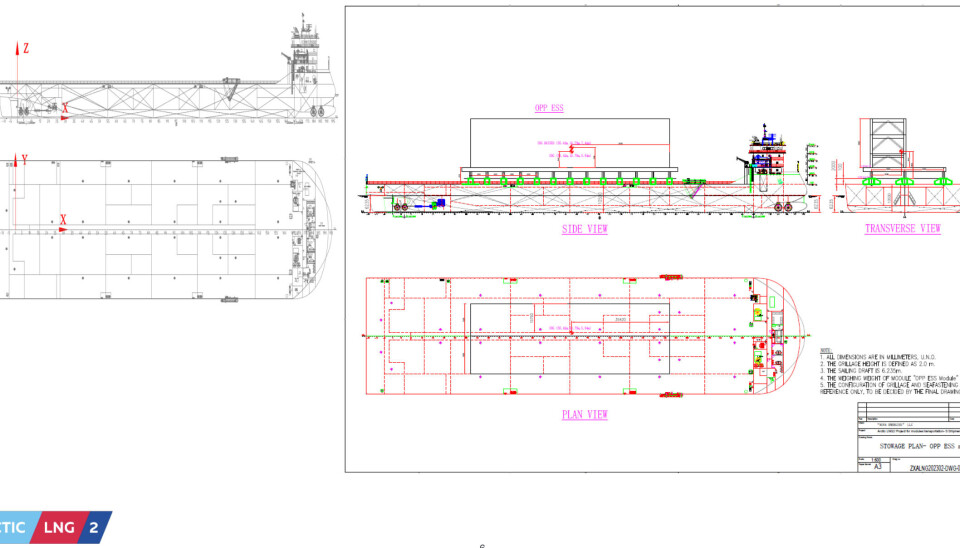
Glory Ocean, formerly named Nan Feng Zhi Xing, and Bright Ocean, previously called Hunter Star, were both involved in earlier deliveries of Arctic LNG 2 modules in 2024 and were later targeted by U.S. sanctions. The vessel’s owner, Guangdong Nan Feng Shipping Co, could not be reached for comment.
Despite those restrictions, the ships continue operating in support of Russian energy logistics, illustrating the challenges Western governments face in constraining supply chains linked to strategic Russian energy projects.
The shipment therefore represents more than a routine logistics operation. The future destination of Train 3 equipment could provide one of the clearest signals yet about Novatek’s longer-term LNG strategy.
Whether the modules are ultimately installed on Arctic LNG 2, redirected to another proposed Russian project like Murmansk LNG, reserved for use in Polar LNG, or simply placed into storage at Belokamenka may reveal how the company intends to navigate sanctions, technical constraints, and an increasingly uncertain project pipeline.


